As you will know, I (Neil) have been processing a lot with the Lord about the season we are in. It’s been a different kind of year as we pioneer something new, and I have been learning a lot about myself and the God that I follow. The other day, as I was reading and praying in the garden (yes, the weather has been awesome), I felt the Lord give me some insight into where Janet and I are currently. I felt Him impress clearly on my mind that we were in a neutral zone in our lives. That term might not mean anything to you, but it means an awful lot to me. You see, there’s a book called ‘Managing Transitions’ that I read many years ago as I was learning how to navigate change and transition, both personally and with the team we were leading at the time. The book proved to be a bit of a textbook when it comes to the area of change and transition, and what I realized was the principles in it can help all of us when it comes to life navigation. Let me share some of those principles with you if you don’t mind!
The first thing that caught my attention in the book came when the authors highlighted the difference between change and transition. They define change as “the physical alterations in our lives.” This could be a new job, a new house, a medical diagnosis, the birth of a child, etc. The changes can be positive or negative, but what is key about a change is that we don’t necessarily have influence over it; they just happen whether we like it or not. E.g., we have to move house due to financial reasons or geographical needs, and we need a new job because the old one came to an end. However, transition is different. The authors define transition as “the emotional and spiritual reaction to the physical changes in our lives.” This is the internal stuff. It refers to the adjustment to the new job, house, diagnosis, child, etc., rather than the physical change itself. The implication here is that we can be living in a new place, working a new job, with a new child, while being sick, i.e., experiencing a lot of change, but we have not transitioned to our new physical reality. We emotionally and spiritually are still living in the old place, working the old job, without the new child, and ignoring the new diagnosis. The failure to transition rather than the physical change is often what doesn’t allow us to move forward into what God is preparing us for and preparing for us.
Transition is a complex process and it is often a struggle for us. I’m currently reading the account of the Israelites on their journey from Egypt to the Promised Land. It’s been a tough journey for them physically but even tougher spiritually and emotionally. Huge change and huge transition. As I once heard a great teacher say; “It was easier to get the Israelites out of Egypt than it was to get Egypt out of the Israelites.” What we are seeing through this example is that the change was easier than the transition – that’s not to downplay how hard it was to free the Israelites from Egypt, by the way. The journey the Israelites took, both the change and the transition, is such a helpful guide for all of us. The authors talk about three stages of transition; the ending, the neutral zone, and the new beginning. What’s interesting about these three stages is that all three are always at play throughout our transitions, but to greater and lesser extents (see the diagram below). If we take the Israelite journey as our example, we see that in the beginning it was mostly about leaving Egypt (the ending) and them accepting that they needed to go. Even in the ending, there is still a bit of the other two stages. The journey through the wilderness is their neutral zone, but again the other two stages are present, and by the time the Israelites are in the Promised Land (the new beginning), there has been a swing in the proportion of the stages, but the other two have not disappeared. It’s a fascinating insight.
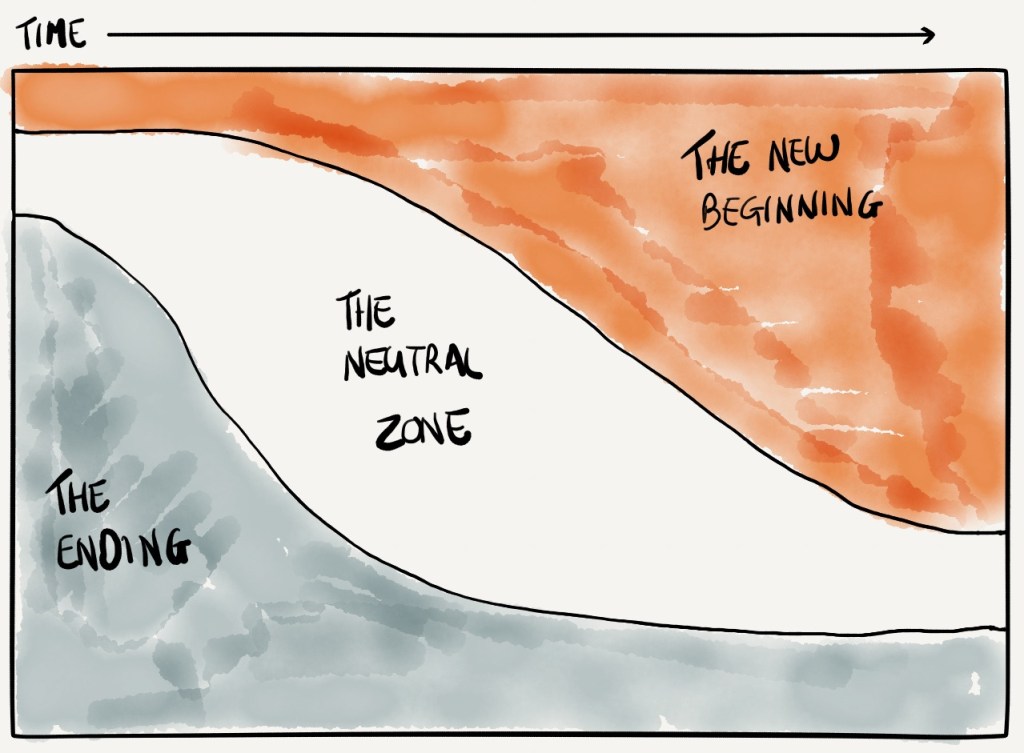
The part of transition I want to write about today is the middle part; the neutral zone. It’s where we find ourselves at the minute. We ended our previous season, which lasted for close to 20 years, around 18 months ago. In that moment, we were in the ending, taking a step into the neutral zone, with not much idea of what the new beginning would be. This year, as you will know, we have started to walk into that new beginning increasingly, but when God spoke to me the other day, I realized that the neutral zone is still a large part of our everyday. That helps me to understand some of why I have been feeling how I have been feeling – let me explain.
The neutral zone, like the other two sections of transition, has all three things at play, but arguably it has the greatest mix of all three, making it one of the hardest parts of transition. Again, we can see this in the stories of the Israelites in the wilderness, where they ended up spending 40 years wandering rather than the 2-week journey it probably should have taken. The reason it took so long wasn’t because they couldn’t navigate the physical direction or change—whilst they didn’t have maps, they would have worked it out in time—but they couldn’t navigate the emotional and spiritual change they had experienced. They were no longer slaves in Egypt, but they weren’t yet free in the Promised Land. They were out of the place they had been oppressed, but they weren’t yet in the place where they would rule. God needed to do a work in them in the in-between before they would be ready for the next. The authors tell us that the neutral zone is “when the critical psychological realignments and repatternings take place, because while you are in it, forward motion seems to stop while you hang suspended between what was and what will be.” It can be a worrying time because all the old certainties break down and everything is fluid. I can testify to that and have been feeling those emotions in recent months. Here are some behaviors which can be very common in the neutral zone.
- Our anxiety can rise, and our motivation can fall. We can feel disoriented and self-doubting. We can be resentful and self-protective. We can divert energy away from our work and focus it toward coping tactics. The research states that in many offices, this point is where sickness and absenteeism are at their highest.
- Old weaknesses, previously patched over or compensated for, reemerge in full force. We can feel overloaded; we frequently get mixed signals, as our habits are in flux and increasingly unreliable. In a business, staff turnover will increase.
- Because the neutral zone is weird, it is easy for us to become polarized: sometimes we want to rush forward, and sometimes we want to go back to the old ways. Consensus can easily break down with others, and disagreement rises.
I don’t know about you, but I found it really helpful when I first read those things. There have been times on our journey this year when I have felt many of those emotions. The problem was in feeling them; I thought there was something wrong with me—just me. That can leave you feeling like you are a problem, the only one who has ever felt like that, and so it was a relief to hear that much of what I was feeling is normal for someone who is journeying through transition. Of course, that doesn’t mean that I can camp out there! It explains my current state, but it doesn’t excuse me from displaying any behaviors that are contrary to a life of faith in Christ.
I guess I’ve been writing for long enough here, but I want to finish by talking through ways to help us navigate these neutral zones in our lives. I’m preaching to myself as much as anyone else here, but I hope it might help you too. If we find ourselves in a neutral zone, we should:
- Accept where we are – take stock of the season we are in. What we’ve been through is done, and what we will do hasn’t fully begun. Realize that we’ll still be dealing with some grief from the past along with impatience for the future. While this isn’t the new normal, it is a temporary normal that could continue for longer than we might hope. We must learn to create and sustain new rhythms and habits in this season that will serve us while we are here. The Israelites in their neutral zone either longed for Egypt or wanted to storm the Promised Land. They refused to accept the wilderness as a place of life and learning for them. They refused to recognize its value.
- Embrace the space that the neutral zone can afford us. I know that the neutral zone isn’t a holiday in the sun, but usually some of the weight and responsibilities in that season can be different from what they were previously and what they will be in the future. We should take time in that space to allow God to speak to us. Of course, He is always speaking, but this new space will require new instruction. We must take stock of where we have been and where we think God is calling us; the lessons and guidance gained through this will serve us well for the future. It’s a space to pursue the work of healing, processing, and forgiveness. A space where we can talk through our fears and learnings from the past and for the future. A space where we allow God to speak courage into us. The neutral zone is a space to learn new things and assess old things.
- Remember who we are – because our roles and routines tend to be a little off in this zone, it is common for us to wonder what value we are adding. We can feel a loss of our sense of purpose. That sense of purpose we might be mourning for can have an impact on our identity if we aren’t careful, and we can hear the gentle whisper of “who are you?” It’s vital to remember that who we are is unchanged. God created us as sons and daughters, and that doesn’t change because our roles and routines have. It was in the Israelites’ neutral zone that God began to reveal both His identity and theirs because this zone is the best place to do it. It has fewer distractions of human achievement or success to mask or hide our true identities. It is more exposed and revealing. Our identity can be solidified in this space.
- Resist the need to find certainty – I believe that even the freest spirit desires certainty in some area of their life. We need foundations and truths that our lives can be built on. In the neutral zone, we so want to find certainty and a foundation quickly because we hate the fluidity of this season. I know personally that I can get lost wishing for a more planned calendar, a steady salary, and clear direction; those things bring me comfort. However, in the neutral zone, God wants me to ask Him what to do daily, trust Him for provision each month, and allow Him to form the future. There is a lesson on dependence for us in the neutral zone that we will carry into the new beginning, but we must not short-circuit this process. Allow God to do the work required.
Anyway, that’s enough from me! I hope it was helpful
 theonehundredyearsproject
Leave a comment